Technological Innovation for Resilience and Sustainability: Insights from the Energy-Intensive Ecosystem
The study presented at IAMOT 2024 in Porto is now published in the new book:
Human-Centred Technology Management for a Sustainable Future
Edited by Zimmermann, R., Rodrigues, J. C., Simoes, A., & Dalmarco, G. (2024) for Springer.
This study investigates how technological innovation can foster both supply chain sustainability and transformative resilience, focusing on the European energy-intensive ecosystem. Through multiple case study analysis, the research identifies key technology-driven actions implemented at different levels by a set of steel and metal companies to enhance their sustainability and resilience, such as heat recovery systems and waste recycling initiatives. Collaboration emerges as a fundamental enabler across all levels of the supply chain, highlighting the importance of cross-sector cooperation. The findings highlight the interconnectedness of technological innovation, collaboration, and learning as key enabling capabilities in driving the supply chain transformation.
Within the energy-intensive ecosystem outlined by the EU Commission, the steel sector is a key industry that makes up a significant part of the European industrial and economic landscape. This ecosystem, which also includes the chemical, paper and mining industries, is essential for the supply of intermediate products in various sectors and works closely with the energy, waste and recycling industries. The steel industry, not only generated a turnover of 125 billion euros in 2021 but also employed 310,000 people and produced 153 million tons of steel annually. The output of this sector underlines its crucial role in supporting almost 2.5 million indirect jobs and the essential contribution to the EU’s industrial framework and economy.
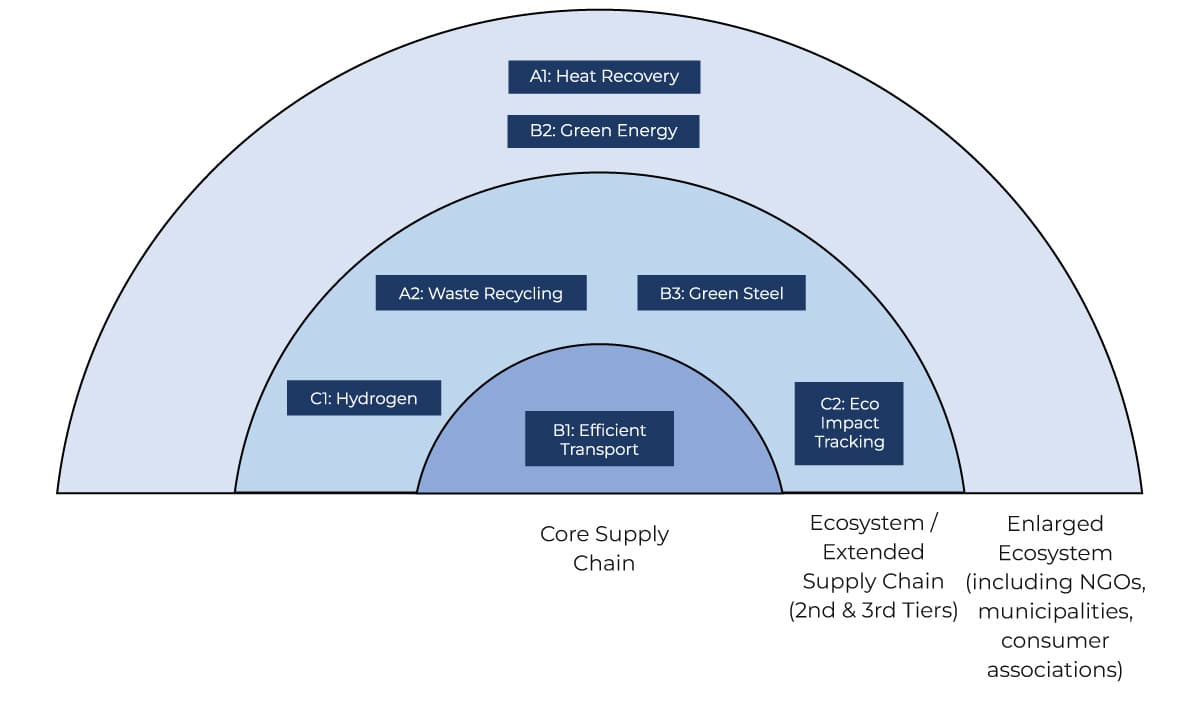
Some actions are implemented by companies to transform this ecosystem thanks to new partnerships with companies (including competitors) creating industrial symbiosis (A2) or operating with the enlarged ecosystem with actors such as public entities (A1 and B2). The learning process leverages on the transferability of best practices to all companies belonging to the steel ecosystem through a replicability process (A1, A2). The adoption of other actions like C1 helps to increase awareness of the potential and viability of technologies like green hydrogen, to reduce the problem of critical dependencies from fossil fuel companies. The reinforcement of the relationship with the 2nd and 3rd tier suppliers like in B3 and C2 facilitates the ecosystem to be more resilient thanks to the visibility and traceability of the processes. Regarding sustainability in energy-intensive sectors, actions A1, B1, and C1 make the most direct contributions toward achieving carbon neutrality. Actions A1 and C1, while yielding significant impacts, are largely tailored to specific industry characteristics, restricting their wider applicability
You can also download the paper here.
Frida Betto University of Padua, CNR-IEIIT
Rosanna Fornasiero CNR-IEIIT
Nils Saorski, Markus Witthaut Fraunhofer IML
Andrea Zangiacomi CNR-STIIMA