ReSChape Workshop Explores the Impact of EU Policies on Supply Chain Resilience
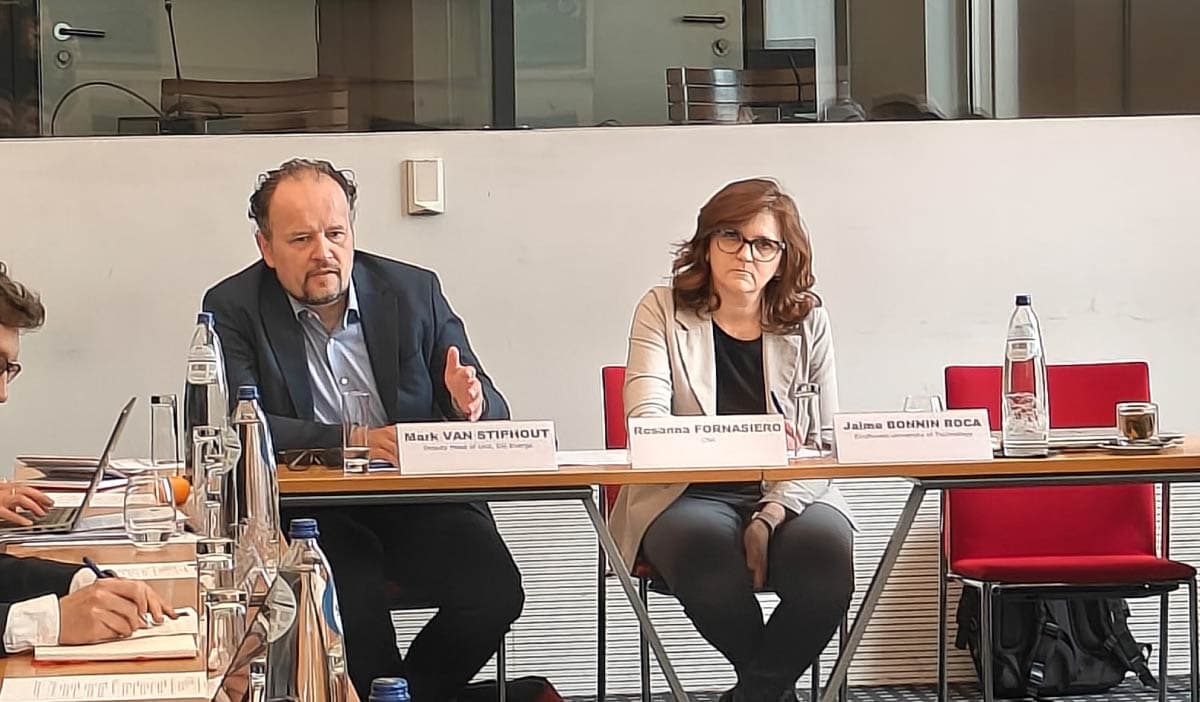
On May 22, 2025, the ReSChape project hosted a high-level policy workshop titled “EU Policy and Supply Chain Resilience” at the Résidence Palace in Brussels. Organized by Eindhoven University of Technology (TU/e), the event gathered 28 participants, including European Commission officials and private sector representatives, for an in-depth exchange on the evolving regulatory landscape and its implications for the resilience of European supply chains.
The ReSChape consortium was represented by a strong delegation of researchers: Rosanna Fornasiero (CNR), Aris Matopoulos (Cranfield University), Boris Blagov and Torsten Schmidt (RWI Essen), Markus Witthaut (Fraunhofer IML), and Pedro Senna (INESC TEC and TU/e).
As project coordinator, Rosanna Fornasiero opened the event with an overview of the ReSChape project, its aims, consortium members, and emerging research outcomes.
Jaime Bonnin Roca, lead organizer of the workshop from TU/e, set the tone for the day by outlining the complex relationship between EU regulations and supply chain resilience. He noted that while resilience is not explicitly targeted by current regulations, the constraints and conditions they create have significant indirect effects. “We are here to discuss how EU policies and regulations affect resilience”, he remarked. “Resilience is shaped not by specific rules, but by the regulatory boundaries within which supply chains operate”.
The workshop unfolded over three interactive sessions. The first, focused on industry insights, featured presentations from private sector representatives who shared first-hand experiences of how EU regulations are impacting their supply chains. Diego Centurion (Global Organic Textile Standard) reflected on challenges in the textile sector, particularly around compliance with new regulations such as the Digital Product Passport. Dorothée Arns (European Association of Chemical Distributors) discussed the growing cost and complexity burden on European SMEs, while also highlighting initiatives to boost circularity and resilience in the chemical sector. Joris Teer (EU Institute for Security Studies) presented survey findings on de-risking critical raw materials, underscoring the EU’s vulnerability to geopolitical shocks, especially concerning rare earth elements.
Session two turned to governmental efforts to enhance supply chain resilience. Filip Bertilsson (DG GROW) introduced the Internal Market Emergency and Resilience Act (IMERA), a flexible policy framework designed to detect and respond to market disruptions through contingency planning, vigilance, and emergency response modes. Corinna Hartung (DG HERA) outlined HERA’s preparedness and emergency strategies to safeguard medical countermeasures, including joint procurement, bottleneck analysis, and international supply risk assessments.
The final session centered on future directions and policy recommendations. Discussion emphasized the need for regulatory coherence, better support for SMEs, and clearer communication of sector-specific requirements. Key challenges identified by participants included resource constraints for smaller companies, overlapping reporting obligations, and the strain of simultaneous implementation of multiple new regulations.
Throughout the day, participants engaged in dynamic discussions that resonated with the core goals of the ReSChape project — particularly its focus on the societal and regulatory dimensions of supply chain resilience. The workshop created a valuable space for dialogue between researchers, policymakers, and industry voices, reflecting ReSChape’s commitment to practical, policy-relevant research.