


A guide helps companies quantify their value and social impact
- It has been developed by researchers at the University of Deusto within the framework of the ReSChape Project, to support companies in measuring their social contribution and strengthening alignment with European sustainability and transparency frameworks.
- ReSChape (2022–2025) is a European project that analyzes impacts on supply chains and proposes models to make them more sustainable and resilient.
Zaragoza (Spain), July 24, 2025 – Helping companies measure and manage their social value under the new EU regulations is the goal of the guide “Measuring and Managing Social Value in Companies”, developed by researchers at the University of Deusto as part of the European ReSChape project. This project was launched after the COVID-19 pandemic to analyze and assess the impacts and disruptions in supply chains and to provide tools that contribute to making them more resilient and sustainable.
The business environment is undergoing a transformation in which society and regulatory frameworks are increasingly demanding in terms of sustainability, transparency, and social responsibility. Regulations such as the Corporate Sustainability Reporting Directive (CSRD) and the Corporate Sustainability Due Diligence Directive (CSDDD) of the European Union define essential frameworks in this new context. In this scenario, the guide has been developed as a tool that highlights the importance of companies being able to quantify, in monetary terms, the social value they generate in their value chains. This approach offers direct and practical information about the social value created, making it easier for all stakeholders to understand and contributing to more transparent and effective communication of business impact on the environment.
“Companies no longer only contribute to the economy; they must be guided by responsible standards that need to be communicated and understood by the people and audiences they interact with,” explains Alberto de la Calle, researcher at the University of Deusto and head of the working group behind the guide. He also emphasizes that its application allows “identifying gaps between the real and potential contribution of each supplier to the value of a company and its environment, as well as proposing improvement strategies.”


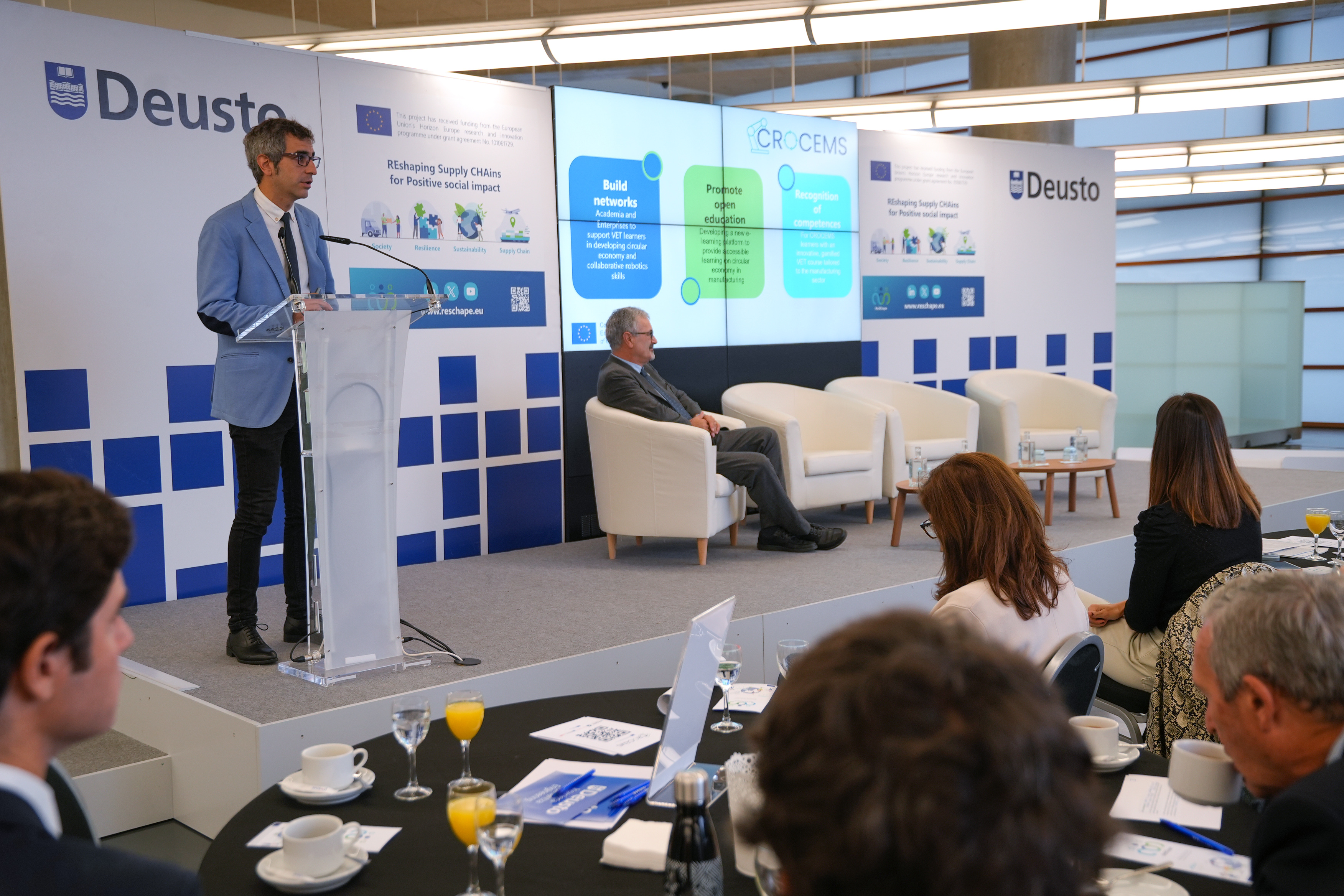
Representatives from the University of Deusto presenting key results of the ReSChape project
The guide uses the Polyhedral Model methodology, which provides a comprehensive view of social value by measuring the value created for each specific stakeholder group. A key aspect of the proposed model is that it relies exclusively on information already available within organizations, such as the number of employees, accounting data, and the specific weight of each supplier in the total volume of purchases.
The guide “Measuring and Managing Social Value in Companies” is one of the practical tools developed within the ReSChape Project, which also includes manuals to support responsible outsourcing of services, innovation strategies to transform supply chain processes, and a report on social, environmental, and climate factors affecting supply chain resilience. A summary of the guide is available here. Those interested in the full document can request it at info@reschape.eu.
About the ReSChape Project
The ReSChape Project (2022–2025) studies and analyzes social, economic, and environmental changes and disruptions to assess their impact on global supply chains. The ReSChape consortium includes 9 partners from 5 European countries plus the United Kingdom and is coordinated by the Consiglio Nazionale delle Ricerche (CNR) based in Rome. The consortium includes the University of Deusto, Zaragoza Logistics Center (ZLC), Inesc Tec – Institute for Systems and Computer Engineering, Technology and Science (Portugal), Fraunhofer Gesellschaft Zur Förderung der Angewandten Forschung (Germany), RWI Leibniz Institute for Economic Research (Germany), Eindhoven University of Technology (Netherlands), and IRIS Technology Solutions S.L. (Barcelona).
It was launched after the COVID-19 pandemic with several key objectives, such as providing new innovative models to make supply chains more efficient, placing people (workers, consumers, and citizens) at the core of business activity supported by technology. It also explores how to ensure beneficial social impact, with innovative policy scenarios and recommendations for future supply chains.
The project addresses challenges such as crisis resilience, sustainability, and digitalization—critical topics identified in reports by the World Bank and the OECD following the pandemic.