


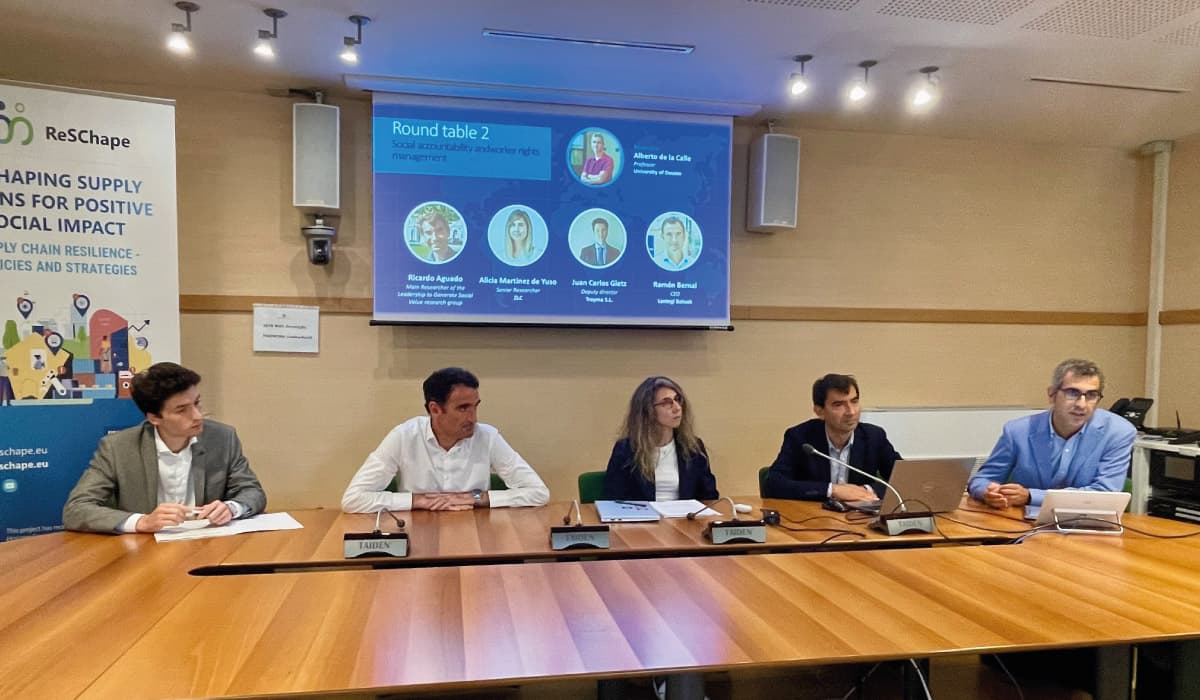
Roundtable 2: Social Responsibility and Workers’ Rights Management
Moderator: Alberto De la Calle (University of Deusto)
This roundtable brought together experts from academia and industry to discuss how to better integrate social responsibility and workers’ rights into supply chain management. The discussion combined theoretical perspectives drawn from the ReSChape project with practical experiences from both large organizations and SMEs.
Dr. Ricardo Aguado (University of Deusto) opened the session by highlighting the importance of social accounting as a tool for measuring and communicating the real social impact of companies. He explained that frameworks such as the Polyhedral Model, introduced in ReSChape, allow companies to capture the economic, relational, and environmental dimensions of value, making their contribution to society more visible and comparable. He also highlighted that EU regulations (CSRD and CSDDD) reinforce the need for companies to integrate social responsibility into their business models and information systems.

Alicia Martínez (ZLC) focused on the challenges of outsourcing logistics activities and its consequences for employment. She presented the findings of ReSChape’s research on the “outsourcing wage penalty” and the risks of a two-tier labor market, where outsourced workers face less stability, lower wages, and weaker representation. She also presented the KPI framework developed within the project, designed to monitor risks such as pay disparities, transparency in outsourcing, and health and safety conditions. According to her, these indicators act as early warning tools for companies to detect vulnerabilities and align their outsourcing strategies with social sustainability goals.
Ramón Bernal (CEO of Lantegi Batuak) shared his organization’s extensive experience in implementing social accounting. Lantegi Batuak is a non-profit organization that has been integrating this methodology into its annual reporting model for years, systematically assessing its social impact and providing feedback to all stakeholders. This practice not only strengthens accountability but also fosters dialogue with employees, public authorities, customers, and society at large.
Juan Carlos Gietz (Deputy Director of Trayma) presented the perspective of an SME, highlighting both the challenges and opportunities of adopting socially responsible practices. While limited resources can make implementation difficult for smaller companies, Trayma has proven the importance of involving employees in operational, informational, and decision-making processes. It also emphasizes working closely with suppliers. All of this strengthens trust with stakeholders and creates opportunities for collaboration within the supply chain itself. However, this is not a simple matter; it requires a shared vision, which is often obscured by vested interests or a culture of continuing to work alone.
The roundtable concluded that social responsibility and the management of workers’ rights are essential for building resilient and fair supply chains. By adopting robust frameworks, engaging with stakeholders, and aligning with EU sustainability regulations, both large and small companies can strengthen their social impact and contribute to more equitable supply chains in Europe. Despite this, recognizing that both customers in particular and the market in general do not value it, implementation is difficult.